
The short version
- My basement radon averaged about 92 Bq/m³ (2.5 pCi/L) in the six weeks before the ERV and about 57 Bq/m³ (1.5 pCi/L) after it, roughly 38% lower. That is one house, and radon also changes with the weather.
- An ERV is not a radon fix. It dilutes your indoor air with outdoor air. If your radon is high, talk to a certified radon professional.
- When I shut the ERV off for wildfire smoke (July 15 to 19, 2026), CO₂ climbed, VOCs roughly doubled and radon jumped within a day. CO₂ is the one the ERV controls best.
- With the doors and windows shut, the ERV off and my purifiers running, my living room PM2.5 averaged about 14 µg/m³ while the nearest outdoor monitor averaged about 200.
- On November 1, 2026 I turned the ERV off again, forgot, and my sensors showed it by morning. Sensors are what tell you the truth.
My house and my setup
I live in a 1920 brick house in southern Ontario, with plaster walls, ten foot ceilings and a forced-air furnace and air conditioner. It leaks, but a leaky house is not a ventilated house. In the fall of 2025 I had a new furnace, air conditioner and ERV put in together.
The ERV is a vanEE V210E75RS (sold as Broan-NuTone in the US). After a lot of research it was the best choice available to me. It balances its own airflow, and its spec sheet gives a continuous airflow of 65 to 210 CFM, which makes it one of the more powerful units I found. It does not connect to my smart home, so I run it from a wall control in the living room.
The air inside the house is measured by four Airthings sensors: a View Plus in the living room and in each of two bedrooms, and a View Radon in the basement. They all feed Home Assistant, so I keep a history of every reading. I bought the sensors first, after I heard about the risks of radon and wanted to know my air quality, and I had them for several months before the new furnace, air conditioner and ERV went in. Those readings sent me down a rabbit hole, and that is how I ended up with an ERV.

Why I chose Airthings
I read up on home radon monitors before I bought mine, and Airthings kept coming out as one of the most accurate I could find. The company states about ±5% on a two-month average. That is Airthings' own figure, not an independent test, so treat it as the maker's claim.
In Canada, Health Canada does not approve radon devices itself. It tells people to test only with monitors on the list kept by C-NRPP, the Canadian National Radon Proficiency Program. Airthings monitors, including the Corentium Home and the View series, are on that list (check the current list for your exact model). Plenty of other brands are not, and Health Canada has recalled some of them. If you are in Canada, check the C-NRPP list before you buy any radon monitor.
Test long enough. Both Health Canada and C-NRPP say to leave a monitor in place for at least three months. A reading from one day or one week can be much lower or much higher than your real average.
What the ERV did to my radon
This is the basement, where my radon is highest. The numbers come from my View Radon, in the six weeks before the ERV and after.
| Period | Average | Notes |
|---|---|---|
| Oct 1 to Nov 9, 2025 (before the ERV) | 92 Bq/m³ (2.5 pCi/L) | 37% of readings were 100 or higher; 51 readings reached 150 or more (the red level on the Airthings scale), with a top of 169 |
| Nov 10, 2025 to Oct 28, 2026 (after) | about 57 Bq/m³ (1.5 pCi/L) | about 38% lower; I found no readings at 150 or more after the ERV went in, and the highest hourly average was 126 |
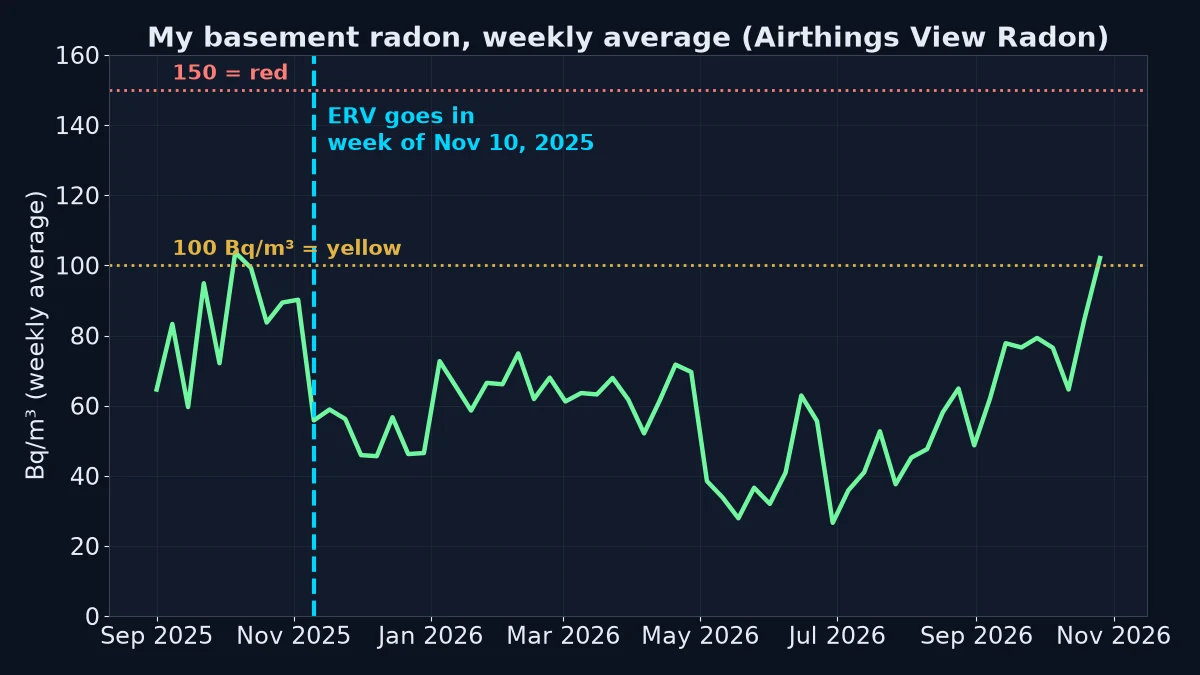
The drop happened in a single week and it held through the winter. That matters, because radon climbs when the weather turns cold, and that is also when you cannot open the windows. An ERV keeps fresh air coming in when the windows have to stay shut. I cannot say the ERV did all of it, because the new furnace and air conditioner went in the same fall. When I compare the same ten days of October a year apart, the difference is smaller, about 13% lower, and I also had the ERV on a lower setting for part of that time.
And an ERV is not a radon fix. My radon is not extremely high, but in the fall it still reaches yellow. In a house like mine, where it is borderline, the ERV helps bring it down. If your radon is high, talk to a certified radon professional about a mitigation system. This is one house.
Radon moves, so I built an alert
Radon came back up this fall. The week of October 19, 2026 my basement averaged about 85 Bq/m³ (2.3 pCi/L), then about 100 Bq/m³ (2.7 pCi/L) from October 26 to 28, close to where it was before the ERV, and that was with the ERV running on medium. So I built an automation in Home Assistant: if the basement radon stays above 100 Bq/m³ for an hour, my assistant sends a warning to my phone. It went off on Monday, October 26, 2026, at 6:49 PM. The ERV is not connected to Home Assistant, so all the alert can do is tell me. I walk to the wall control and turn it up.
The wildfire smoke test, July 15 to 19, 2026
On July 15, 2026, wildfire smoke from fires in northwestern Ontario blew into my area, and an air quality alert went out. My ERV is a ventilation machine that brings outside air into the house, and that day the outside air was smoke. The nearest outdoor monitor read about 182 µg/m³ of PM2.5 at noon and 500 by 3 PM. The World Health Organization's daily guideline is 15.
So I shut the ERV off, kept the doors and windows shut as much as I could, and ran my purifiers nonstop. I could not run the ERV at all for days, or even open a window. Here is what the sensors recorded.
CO₂: the one an ERV controls best
With the ERV off, the living room CO₂ averaged about 779 ppm during the smoke, against about 545 ppm in the two weeks before, and peaked at 1,098 ppm. A bedroom reached 1,194 ppm and was above 1,000 ppm for 36 hours in total. Within a few hours of turning the ERV back on, around July 19, the living room was back under 500 ppm.
VOCs and radon
VOCs roughly doubled, from about 214 to 403 ppb on average in the living room. VOCs are noisy (cooking and cleaning move them too), and the ERV does less for them than it does for CO₂. The basement radon jumped within a day of shutting the ERV off, from about 21 to 50 Bq/m³, and it did not fall back to its earlier level in the following days, so I am not claiming a clean "off, up, on, down" from July.
The particles: the part that matters most
Smoke particles are PM2.5, and the US EPA says these tiny particles can get deep into your lungs and affect your heart. From the morning of July 15 to noon on July 17, the nearest outdoor monitor averaged about 200 µg/m³ and hit 500. In my living room, with the doors and windows shut, the ERV off and the purifiers running, the average was about 14 µg/m³ and the highest hourly reading was 31. That is about fifteen times cleaner than outside, in an old, leaky house. The WHO daily guideline is 15, and my living room averaged just under it.
It was all of those things working together: the doors and windows shut, the purifiers running nonstop and the ERV off. I can't tell you which one did the most. And I do not have an outdoor sensor of my own, so the outside numbers come from the nearest government monitor, not from my yard.
Was shutting the ERV off the right call? I think so. Smoke particles do more harm to your heart and lungs than a few days of higher CO₂ and VOCs. I would do it again, and I would follow my local public health advice.
It happened again: November 1 and 2, 2026
On Sunday, November 1, 2026, I turned the ERV off in the afternoon because I could smell smoke outside. Then I forgot it was off. The sensors told me the rest.
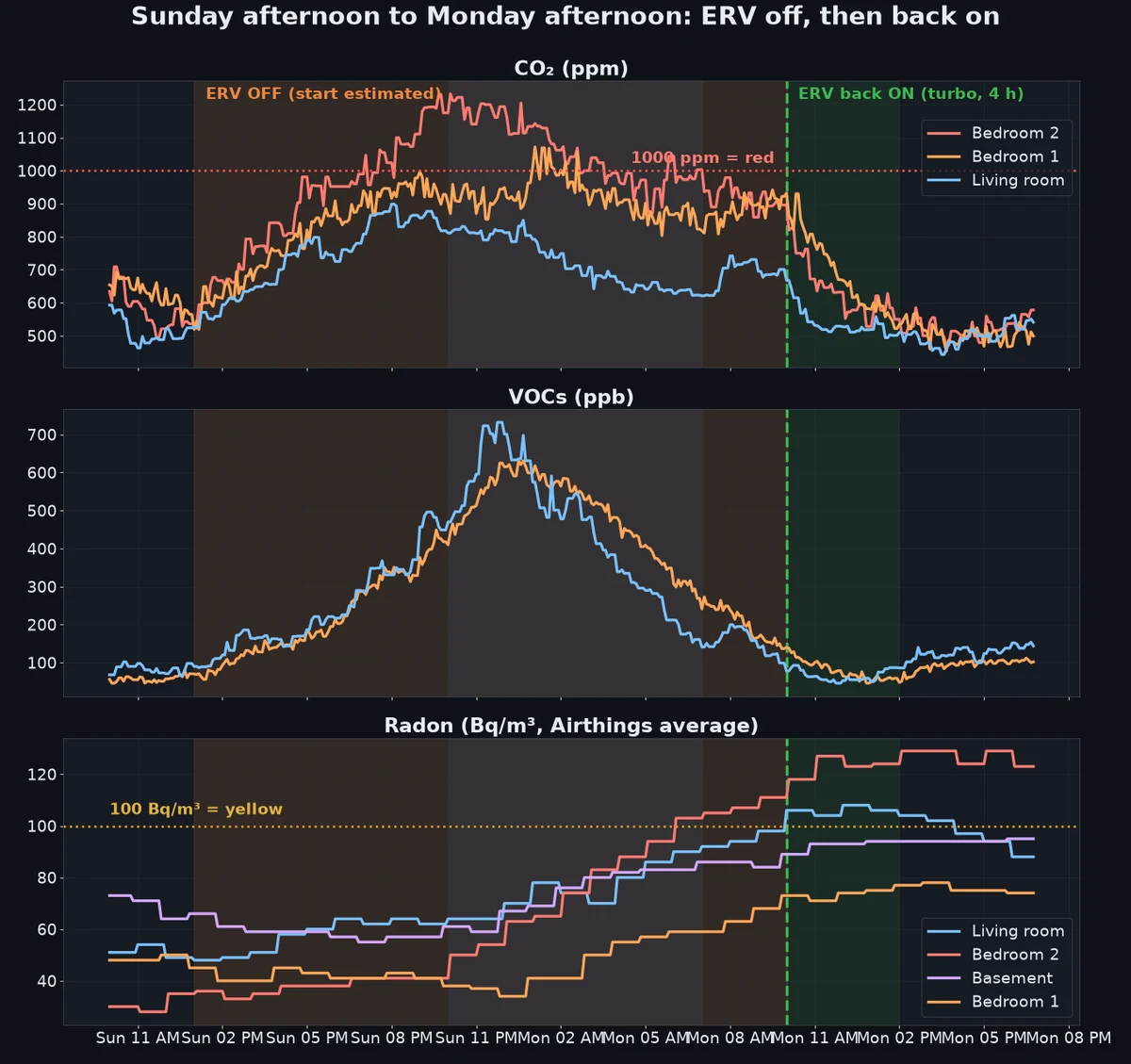
- CO₂: in one bedroom it stayed above 1,000 ppm for about eight hours and peaked near 1,230. In my room it passed 1,000 around 1 AM, and my phone warned me. The room felt stuffy and I did not sleep well. My night average in my room was about 919 ppm, against about 663 the night before with the ERV on.
- VOCs: peaked near 730 ppb in the living room and 630 in my bedroom around midnight, then fell through the night, before I turned the ERV back on.
- Radon: rose in every room while it was off, for example from about 49 to 106 Bq/m³ in the living room. These are Airthings averages, so they lag, and the weather matters too. Still yellow, nowhere near red.
What happened when I turned it back on. At around 10 AM on Monday, November 2, 2026, I turned the ERV back on, on turbo for four hours. By 2 PM the CO₂ in one bedroom had fallen from about 900 to about 550 ppm, in my room from about 930 to about 530, and in the living room from about 670 to about 510. Radon did not come down in those four hours: in the living room it went from 106 to 104 Bq/m³, and in the basement from 89 to 94. That is what I would expect, because the Airthings radon number is a rolling 24-hour average (Airthings explains how it is calculated). A few hours of turbo barely moves it, and the average still contains the night the ERV was off. I am not saying the ERV fixed the VOCs either, because they were already falling before I turned it back on.
That is the catch with an ERV that is not connected to my smart home: it cannot tell me it is off. Only my sensors can tell me that.
What I do about it with Home Assistant
The sensors feed Home Assistant, which lets my smart home react to the air. It can run my purifiers, send alerts to my phone, or turn on lights if the levels get too high. My Levoit purifiers (a Core 600S in the living room, a Vital 200S in my bedroom and a Core 200S in the other bedroom) are smart, so I can combine them with the sensors and have them turn on by themselves when the air gets bad. I have built those automations, but in July they were switched off, so I ran the purifiers by hand.
What I am missing is an outdoor air quality sensor. Without one I only know after the smoke is inside. Air quality alerts work when a big area is affected, like wildfire smoke. But a neighbour's backyard fire, which happens a lot on summer nights, or a house fire down the street, does not set off an alert, and it usually is not on the news. A sensor of my own outside would see those, and with the ERV pulling outside air in, that smoke gets sucked right into my house. That is the number one reason I want one. It is an idea I am looking at, and I have not bought one.
What I would tell you
- If you are worried about radon, test. Use a monitor that is on your country's approved list and leave it in place for at least 90 days, ideally in fall or winter. One reading or one week is not a pass or a fail.
- Know the levels. Canada's guideline is 200 Bq/m³ (5.4 pCi/L) as a long-term average. The US EPA action level is 4 pCi/L (about 148 Bq/m³), and the WHO reference level is 100 Bq/m³ (2.7 pCi/L).
- Do not rely on an ERV for high radon. It can help a house that is borderline. High radon needs a certified radon professional.
- If you shut an ERV off for smoke, watch your CO₂. It is the number that tells you what the shut-off is costing you, and it is how I knew I had forgotten.
- An ERV does not clean smoke out of the air. It brings the outside air in, whatever is in it. A HEPA purifier does the cleaning.
This is one house, one set of sensors and one summer of smoke. I am showing you my numbers, not promising yours. None of this is medical advice.
The gear in this post
- Airthings View Plus: CO₂, VOCs, PM2.5, radon, temperature and humidity (I have three).
- Airthings View Radon: the radon-only sensor in my basement.
- Levoit Core 600S, Core 200S and Vital 200S: the smart air purifiers.
- The ERV family I use (Broan-NuTone AI Series in the US, vanEE in Canada).
The links go to my gear page, where the Amazon links are affiliate links. They cost you nothing extra, and they help the channel. If you want to see how my Home Assistant is set up, I have other videos about that, and my setup page lists it all.
Sources
- Health Canada: Guide for radon measurements in residential dwellings
- C-NRPP: Consumer report on electronic radon monitors
- Health Canada: Radon guideline (200 Bq/m³)
- US EPA: Radon
- AirNow: outdoor air quality data
- Broan-NuTone: V210E75RS specifications
Frequently asked questions
Does an ERV reduce radon?
In my house it helped. My basement radon averaged about 92 Bq/m³ (2.5 pCi/L) in the six weeks before the ERV and about 57 Bq/m³ (1.5 pCi/L) after, roughly 38 percent lower. That is one house, and radon also moves with the weather, so I do not claim the ERV did all of it. An ERV dilutes indoor air with outdoor air. It is not a radon fix: if your radon is high, talk to a certified radon professional about mitigation.
Should I turn off my ERV during wildfire smoke?
I did. An ERV brings outdoor air in, so in heavy smoke it brings the smoke in. The trade-off is that CO₂ and VOCs build up when it is off. In my house the living room CO₂ average rose from about 545 to 779 ppm and a bedroom stayed above 1,000 ppm for 36 hours. Follow your local public health advice, and keep an eye on indoor CO₂ so you know what the shut-off is costing you.
Can an ERV filter wildfire smoke?
No. An ERV exchanges air and heat or moisture between inside and outside. It brings outdoor air in, whatever is in it. A portable HEPA air purifier is what pulled the particles down in my house.
What is a good CO₂ level indoors?
A common limit for indoor air is 1,000 ppm. Airthings shows 800 to 1,000 ppm as yellow and above 1,000 as red. My living room normally sits around 500 to 550 ppm with the ERV on.
Is the Airthings View Plus accurate for radon?
Airthings states about plus or minus 5 percent on a two-month average, which is the company's own figure, not an independent test. In Canada, Health Canada tells people to test only with monitors on the C-NRPP consumer list, and Airthings monitors are on it. Short readings can mislead, so leave a monitor in place for at least three months.
How long should I test for radon?
At least 90 days, ideally in fall or winter. One reading or one week is not a pass or a fail. Canada's guideline is 200 Bq/m³ (5.4 pCi/L) as a long-term average, the US EPA action level is 4 pCi/L, and the WHO reference level is 100 Bq/m³.
Can I track CO₂ and radon with Home Assistant?
Yes. My four Airthings sensors feed Home Assistant, which keeps a history of every reading and can send an alert to my phone. For example, I have an alert if the basement radon stays above 100 Bq/m³ for an hour.